blog-1.jpg

Farmkeepers Blog

The Farmkeepers is the official blog of NC Farm Families. It is here that words will flow, our voice will be heard, a stand will be made, and the farm families of North Carolina will be protected. In these posts, we'll set the record straight. You'll see the faces of the families who feed us. Here, you'll receive all the updates and news. It is here that we will fight for farmers and be the keepers of the farm in NC. We hope you'll join us. Follow along on social media and by joining our email list.  
The Truth About Farmers Marisa See The Truth About Farmers Marisa See

Heart of the Matter: What is a Family Farm?

DSC_8934.jpg

Recently, there have been discussions about what a family farm is. The answer seems simple: a farm run by a family. However, because farms don’t always look like they did 50 years ago, there has been some debate and confusion over what a family farm truly is.

We thought it important to address this topic. After all, our name is NC Farm Families. Shouldn’t we be able to provide clarity on who we represent? So here goes:

DSC_8645-2.jpg

A family farm is one that has a family behind it.

It doesn’t matter how large the farm is.

It doesn’t matter if the farm is multi-generational or new.

It doesn’t matter if the family extends to farm employees.

It doesn’t matter if the family chose to contract with an integrator or are independently operated.

It doesn’t matter if there isn’t a red barn.

It doesn’t matter how many or what size the tractor is.

It doesn’t matter.

We do not constrain the term family farm to a certain size or type or the color of their barn. None of that matters.

What matters is that at the heart of family farms is a passion for the vocation, a love for family, and the fortitude to do hard work.

So, when we say that 96% of farms in the USA are family owned and operated, this is what we mean. They’re men and women raising families and feeding the world. They come in all shapes and sizes. Whether they have 10 acres or 1,000 or raise pigs indoors or on the ground, these things don’t define a family farm, their heart does.

DSC_8897.jpg
Read More

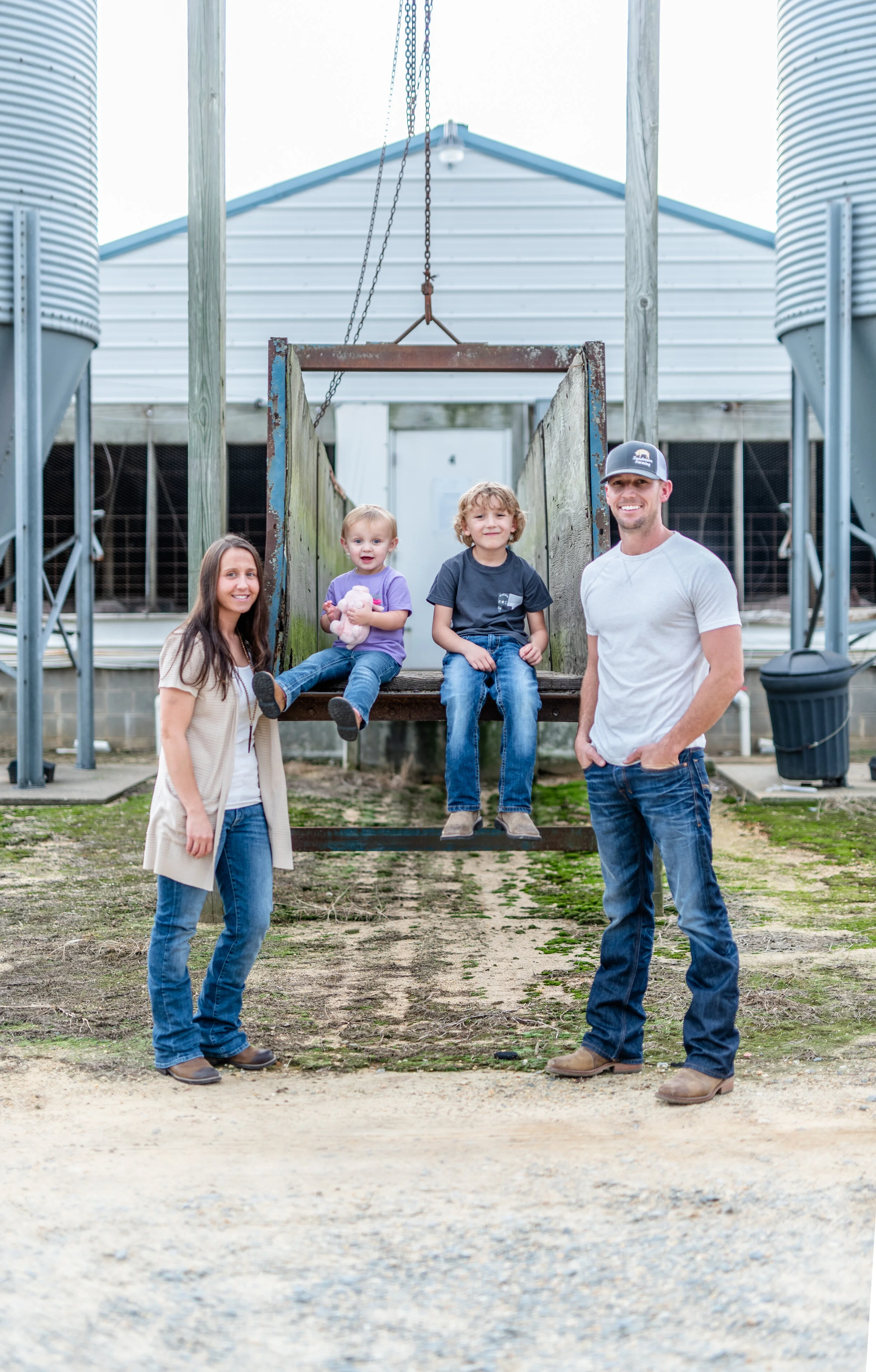
The Bass Family: Raising 3 Sons on the Farm

DSC_8596.jpg

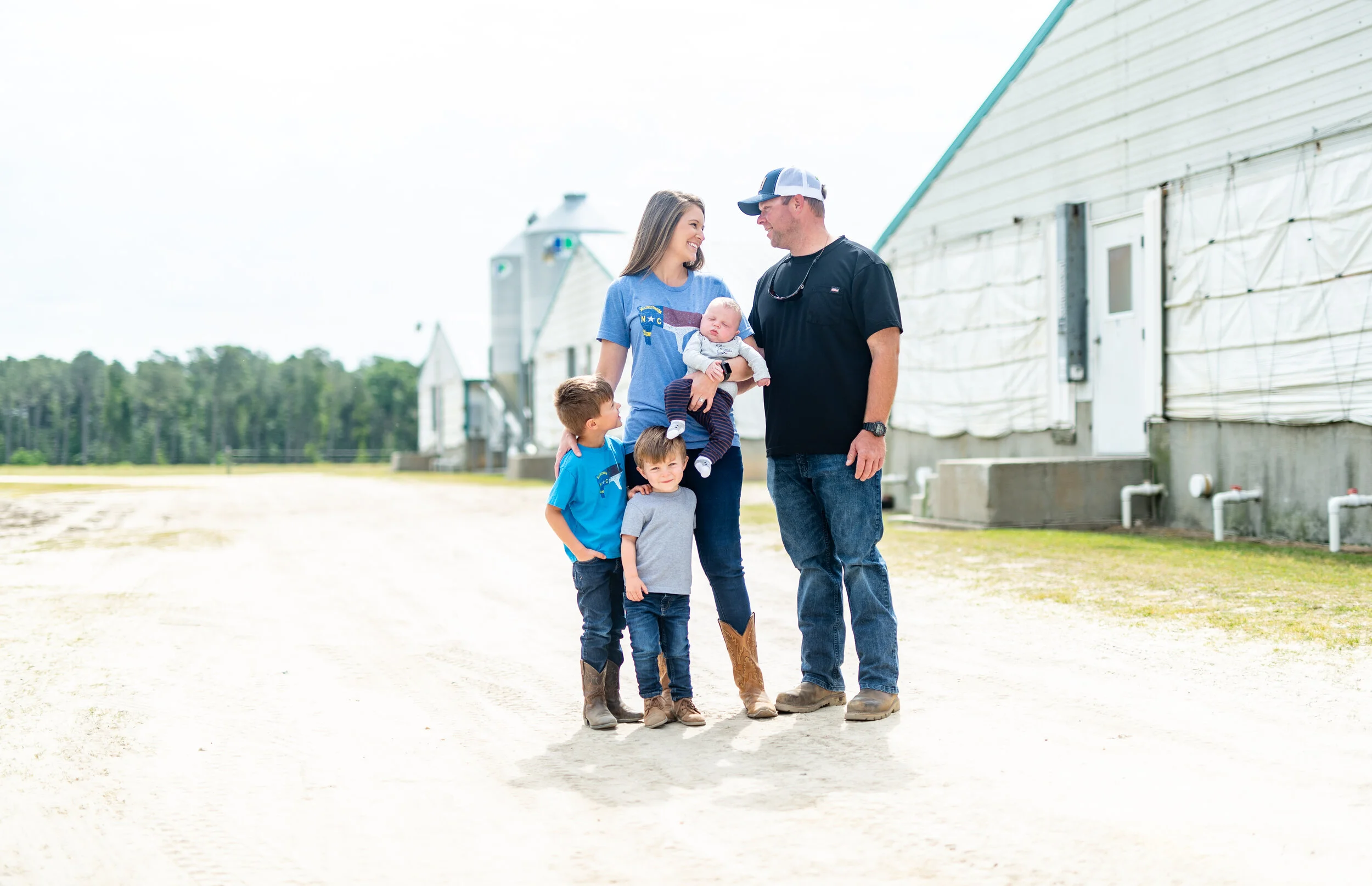
Knox and Crawford Bass race down the dirt path that runs in front of their family’s hog houses. Crawford, who is currently 5, outruns his younger brother who is almost 3. Not winning any races any time soon is baby brother Zane who is only a few months old.

DSC_8576.jpg

The Bass boys are right at home on the hog farm—racing, playing in the dirt, checking on the pigs, climbing feed bins. For them, this is what they’ve grown up with and know. This is their element. What they don’t realize, however, are the lessons they’re learning on the farm. Their parents, though, are hopeful that between the dirt path races, tractor rides, and farm play, something bigger is happening in their sons’ lives.

DSC_8683.jpg

Tyler and Janna Bass met in college at NCSU. Tyler majored in agronomy, while Janna studied business and marketing. Tyler had a clear plan of his future—farming. Janna’s future didn’t have farming in it; that is until she met Tyler.

“When I met Tyler, he said ‘I’m a farmer,” and I remember thinking that I really didn’t know much about that lifestyle and  I had no idea what it took to run a farm and the business aspect behind the operation,” Janna recalled.

Janna grew up right outside of Raleigh in an urban area, and the move to the farm in Sampson County was an adjustment. Even after being married for 10 years, there are times where it is still an adjustment. That’s not to say that she doesn’t like the farm life. She has embraced the farm and the farming community. She actually works with farmers now as the Marketing and Financial Service Manager with Cape Fear Farm Credit, an agricultural lender.

“We assist farmers of all shapes and sizes, new farmers or farmers who have been farming for generations, and we help them obtain the financing they need to start, continue or grow their operation and to ensure its success for the future,” said Janna.

Janna loves her job and working with the agricultural community. She also loves watching the passion her husband has for his job and feeding the world. 

The Bass farm was started by Tyler’s grandad, and later taken over by his dad and uncle. After college, Tyler knew exactly what he wanted to do—come back to the farm. He had always wanted to be a farmer, after all.

“I’ve always wanted to farm ever since I was a little boy. I can remember playing in dirt paths with my trucks and tractors,” Tyler said.

After college, Tyler started to build chicken houses and bought hog houses since then as well. The Bass farm currently grows and raises crops, produce, chickens, cattle, and hogs. Tyler’s favorite part about being a farmer is being outside, watching things grow, and knowing he is helping feed others.

DSC_8696.jpg

His least favorite part about farming is also Janna’s least favorite aspect—the time it can take away from family. Farming is 24/7, especially when livestock is involved, and the sun-up to sun-down hours can be hard.

“Many a night during planting or harvesting season we are sitting around the table, and he’s not able to be there, or I tuck the children in bed and he’s not home yet because he’s still in the field,” shared Janna.

Janna and Tyler aren’t trying to downplay the good in farming. They are simply acknowledging the hardship that is their reality. And yet, in that hardship and challenge, is a lesson for their sons.

With the long hours and hard work, their sons get a front row seat to lessons on a good work ethic. While it may seem that they are simply playing, young children tend to notice more than we realize.

“I hope they observe the work ethic behind what goes into a farm, the dedication, and just the humility that comes along with it,” Janna said. “Farmers are humble and honest, but they really put serving others in front of themselves. I hope my boys see that and apply that to every aspect of their lives.”

DSC_8665.jpg

Whether or not Crawford, Knox, and Zane choose to become farmers, they are learning values that transcend the farm. Humility, hard work, dedication, and service are all traits that any parent hopes their child will learn.

And if the Bass brothers want to become the fourth generation to farm, well, the farmers that came before them have and are putting in the work, sun-up to sundown, to make sure that the farm is able to welcome the next generation on to it’s lands.

“If my boys choose to farm, I hope ag will still be able to sustain them and their families in the future. I hope I can continue to build on the farming foundation my dad and granddad set for me, to pass on to my boys – if that God’s plan for them,” said Tyler of what he hopes for his sons. 

The farm is filled with lessons, and for those who are lucky enough to grow up on the farm, they may not even realize that they are learning at the time. It is doubtful that Knox, Crawford and soon Zane Bass realize that as they check on pigs or ride the tractor with their dad that they are learning life lessons.

While family farms are about providing food, fuel, and fiber for the world, they are also all about raising the next generation. Tyler and Janna Bass are striving to do their part,  to raise Godly, kind, humble, hardworking boys on the farm.

And perhaps in 20 years, the Bass brothers will remember a time where they raced down a farm path and climbed feed bins, smile and realize that they learned so much on the farm. 

DSC_8637.jpg
Read More

NC Farm Act contains no loopholes for industry expansion.

In politics, people often attempt to “twist the facts” in hopes of persuading others to support their views. Other times, they just flat out tell mistruths.


That’s exactly what we saw in a recent WRAL opinion column about the NC Farm Act, which was signed into law this week. The article, written by a Duke law professor who is a frequent critic of North Carolina’s pork industry, falsely claimed that the legislation would allow pig farms “to expand for the first time since 1997.”

That’s simply not true.

Let’s start with some background. The legislature imposed a moratorium on new or expanded pig farms in 1997. That moratorium became permanent in 2007. As a result, no new hog farms have been built in North Carolina in the past 23 years. 

Nothing about this year’s Farm Act changes any of that.  

DSC_0263.jpg

What the Farm Act does do is allow pig farms to cover existing swine manure treatment lagoons or replace their lagoons with a methane digester. The purpose: to capture biogas that can be used to generate clean renewable energy.

These actions represent an advancement in manure management that should be celebrated by environmental groups. 

Instead, they are trying to stoke fears with false accusations.

The legislation is clear. It specifically prohibits the construction of new farms or the expansion of existing pig farms that don’t meet strict environmental performance standards. 

This legislation simply codifies into law what the NC Department of Environmental Quality has already been doing. Since 2011, the department has issued more than 20 permits for pig farms to cover their treatment lagoons or install methane digesters.

These new technologies are being adopted by more farmers across the state, representing an innovative step in how pig manure is managed. It is an advancement that should be encouraged.(The professor also tried to attach pig farms to an issue reporters care deeply about: public records. A separate provision in the bill aligns local and state privacy concerns with existing federal law. It has very little to do with pig farms, which account for only about 3% of the records at issue.)Sadly, some folks just can’t acknowledge there are positive steps being taken by family farmers and pork producers. They contort themselves into odd positions just to oppose progress — because they oppose modern agriculture. 

Sadly, too, they toss aside facts and disregard the truth. 

81550092_2520207501552105_6635731546131136512_o.jpg
Read More