Misleading Jurors & Spinning Tales in the Courtroom--What's Not Being Told in the Hog Nuisance Cases

The lawyer suing Smithfield Foods has a genius for creating villains in courtrooms – and he’s painted a picture of Smithfield Foods as an arrogant corporation driven by greed. For example, in the first trial Michael Kaeske told jurors Super Soils, which is one way to treat waste, was a ‘magic wand’ to cure all the problems caused by hog farms, and then he asked Smithfield executive Greg Schmidt, Why didn’t you implement Super Soils?
Greg Schmidt: It wasn’t economically viable.
Michael Kaeske: Did Smithfield do a study to determine how much it would cost to put Super Soils on its farms?
Greg Schmidt: No.
Kaeske made Smithfield look like a villain – it claimed Super Soils wasn't economically viable but it hadn’t done a study to determine what they cost. But Kaeske left out part of the truth. Smithfield didn’t do a study itself – instead it had funded a study by scholars at North Carolina State University to determine whether Super Soils was cost-effective. The research showed it wasn't. But Kaeske never mentioned that.
In the fourth trial, repeating the same point, Kaeske drew a bead on Wendell Murphy. Wendell Murphy, he said, was rich. He was the father of modern hog farming in North Carolina. And when he served in the state legislature he’d passed bills to make himself and other hog farmers wealthier. What did Kaeske leave out this time?
Wendell Murphy grew up on a farm in Duplin County, graduated from North Carolina State University in 1960, then returned to Rose Hill to teach high school. He also started raising hogs the old-fashioned way, outside in a field. Then, in 1969, a hog cholera epidemic hit and the Department of Agriculture destroyed his 3,000 pigs. He picked himself up, started over, and later he was one of the first farmers to raise hogs indoors.
Thirty-six years ago, in 1982, Wendell Murphy was elected to the State Legislature. He left the legislature twenty-six years ago in 1992. Michael Kaeske attacked Murphy for four bills that were passed decades ago. And Kaeske left out a key fact: “Those laws – adopted in the 1980’s and early 1990’s – often passed without a dissenting vote,” the News and Observer reported. Democrats voted for them. Republicans voted for them. The Secretary of Agriculture – a Democrat – supported them. The Governor – a Republican – supported them. For a simple reason: Tobacco was waning as a crop and the bills helped families continue to farm by raising hogs and chickens and turkeys.
Michael Kaeske didn’t mention any of that. In a courtroom, where the goal’s a fair verdict – based on the truth – Michael Kaeske spun a tale to mislead jurors.
This is the part 3 in a 6 part series about the hog nuisance cases.
Reviewing the First 4 Hog Nuisance Trials--What You Need to Know
As we’re waiting for the fifth trial to begin, let’s re-examine the first four trials.
Fact #1: The trials didn’t happen because an irritated neighbor drove to a local lawyer’s office, sat down and said, My neighbor’s hog farm’s a nuisance. I want to sue him. Instead, a group of lawyers came to North Carolina, knocked on hog farmers’ neighbors’ doors and said, ‘We’ll sue the hog farmer. We’ll pay the bills. You sign here and be a plaintiff. And if we win you’ll get part of the money.’ It proved to be an enticing offer. It’s why we have these lawsuits.
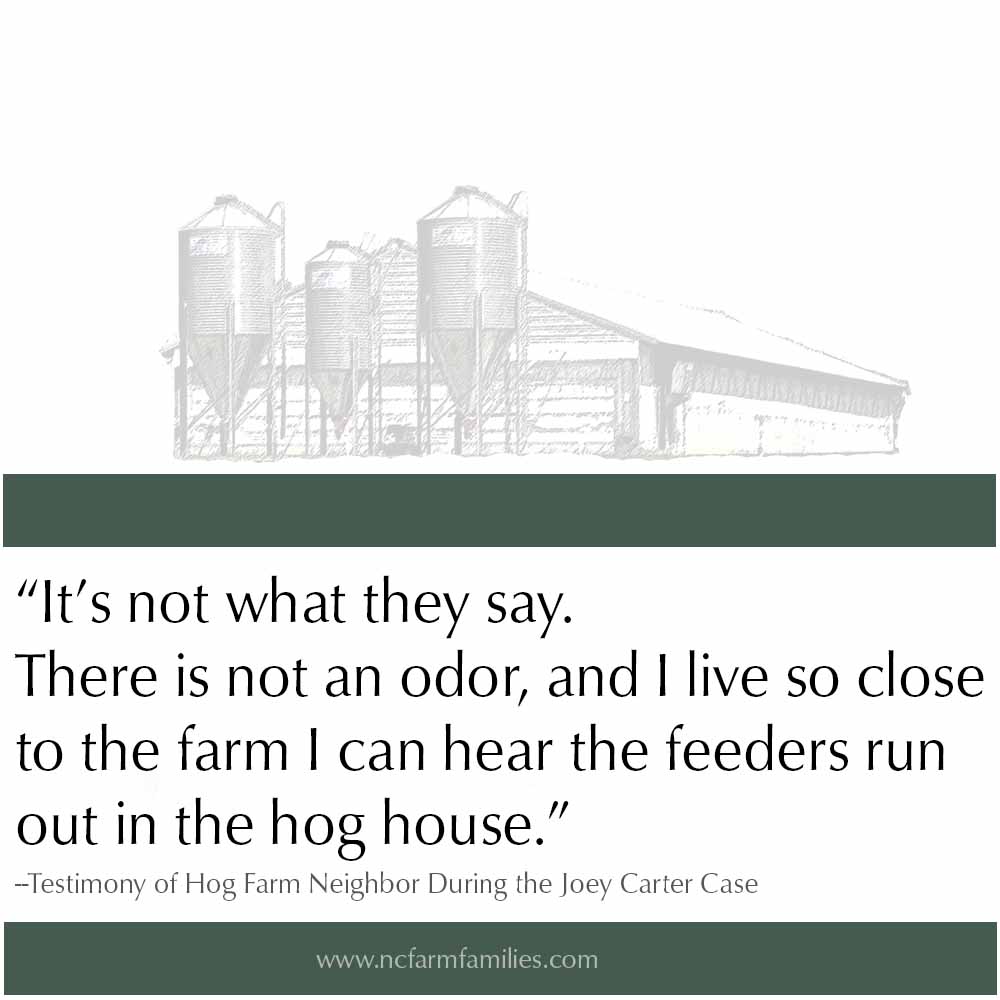
Fact #2: Oddly, no juror heard about that fact during the trials. The lawyers for the plaintiffs asked the judge to instruct Smithfield’s lawyers not to mention it to jurors. And the judge agreed. Why did that matter?During the Joey Carter farm trial,four of Carter’s neighbors testified for him. One told the jury: “It’s not what they say. There is not an odor, and I live so close to the farm I can hear the feeders run out in the hog house.” Another said: “We live next door. My wife and kids, we walk on the farm and near it. There’s no issue, no concern, no odor.” A third testified what was being said about Joey Carter’s farm did not make sense. And a fourth testified: “I hate to feel like an innocent man is going down.”
A fifth witness, the local postwoman, told the jury, “I can’t tell you the last time I’ve smelled odor from the farm.” Day in and day out, that postwoman had delivered mail to Joey Carter’s farm – and she couldn’t recall the last time she smelled odor.
In addition, a respected scientist who’d done studies at Joey Carter’s farm had found no objectionable odor.
Two neighbors – who signed up for the lawsuits – testified against him.
But neither plaintiff was asked, You lived beside that hog farm for years but didn’t complain – then a lawyer knocked on your door and said, ‘We’ll sue the hog farmer. Join us, we’ll pay the bills and you could make money.’ Is the reason you’re suing to make money?
Wouldn’t that have gone straight to the heart of plaintiffs’ testimony? And their credibility? But no juror ever heard that question asked – or knew even it existed – because the Judge had ruled jurors shouldn’t be told that fact.
Part 2 of a 6 part series
Fourth Hog Nuisance Case was Different than Others--What Changed?

The road dipped, curled and twisted through a hurricane, floods, and four lawsuits against hog farms.
In the first three trials the lawyers suing Smithfield Foods won $545 million (the verdicts were later reduced to comply with North Carolina law). Then, at the end of the fourth trial, the road changed directions. The lawyers asked the court to award between $32 million and $40 million but the jury only awarded a total of $102,400. (Six plaintiffs were awarded a total of $2400, one $25,000 and one $75,000.)
What changed?
Federal Judge Earl Britt had presided over the first three trials but, in the fourth trial, he was replaced by Judge David Faber. It’s not hard to make a case Judge Faber was more even-handed than Judge Britt. For example, in the first three trials Judge Britt instructed juries to decide both ‘Compensatory’ and ‘Punitive’ damages at once – while Judge Faber split the two types of damages apart, allowed the jury to decide compensatory damages first, and then ruled as a matter of law punitive damages were not justified.
Smithfield Foods also had a new lawyer in the fourth trial. In the first three trials the plaintiffs’ lawyer, Michael Kaeske, showed a genius for villainizing Smithfield in the courtroom. In the fourth trial Smithfield’s new lawyer fought back successfully.
And, of course, the biggest difference is the amount of the verdict dropped in the fourth trial.
Why does that matter? The lawyers filed these lawsuits against Smithfield Foods to make money. They receive 40% of each verdict plus their expenses. In a trial that lasted four weeks, will their share of a verdict of $102,400 be enough to make a profit? Probably not.
During the first three trials the road ran from bad to worse to worst for hog farmers, but in the fourth trial the road changed directions. Which is an encouraging sign.
The fifth trial – with Judge Britt presiding again – was scheduled to begin last week. But, then, the road curved again. The trial was postponed due to the government shutdown. When will the trial start? We’ll keep you posted.
This is part 1 of a 6 part series.

Farmkeepers Blog
The Farmkeepers is the official blog of NC Farm Families. It is here that words will flow, our voice will be heard, a stand will be made, and the farm families of North Carolina will be protected. In these posts, we'll set the record straight. You'll see the faces of the families who feed us. Here, you'll receive all the updates and news. It is here that we will fight for farmers and be the keepers of the farm in NC. We hope you'll join us. Follow along on social media and by joining our email list.
Featured posts:


Our Sponsors