Farmkeepers Blog
The Farmkeepers is the official blog of NC Farm Families. It is here that words will flow, our voice will be heard, a stand will be made, and the farm families of North Carolina will be protected. In these posts, we'll set the record straight. You'll see the faces of the families who feed us. Here, you'll receive all the updates and news. It is here that we will fight for farmers and be the keepers of the farm in NC. We hope you'll join us. Follow along on social media and by joining our email list.
Pig farmers reduce environmental impact | Activists push back
Greenhouse gas emissions (GHG) are a national (and global) concern, with blame being directed everywhere from fossil fuels to cow farts. Included in the blame game, at least in North Carolina, are pig farms.
Terms like “toxic,” “polluters,” and “cesspools” have been used to describe pig farms in North Carolina. According to activists, they really have a problem with how we handle manure. They view the lagoon and spray field system as an “antiquated” method that needs to be abolished. Activists have sued over “odor” and effectively shut down several farms. In these lawsuits, they never requested a change in the system (just millions of dollars) but did highlight alternatives that could be implemented.
Fast forward to recent months. Farmers have been working together with Dominion Energy and Smithfield Foods to implement years of research to cover lagoons, capture methane, and turn it into renewable natural gas, which in turn, produces electricity. Note, this was one of the alternatives encouraged by activists in court. Now they oppose it, with claims that it may make things worse.
Confused? Get ready to become more so.
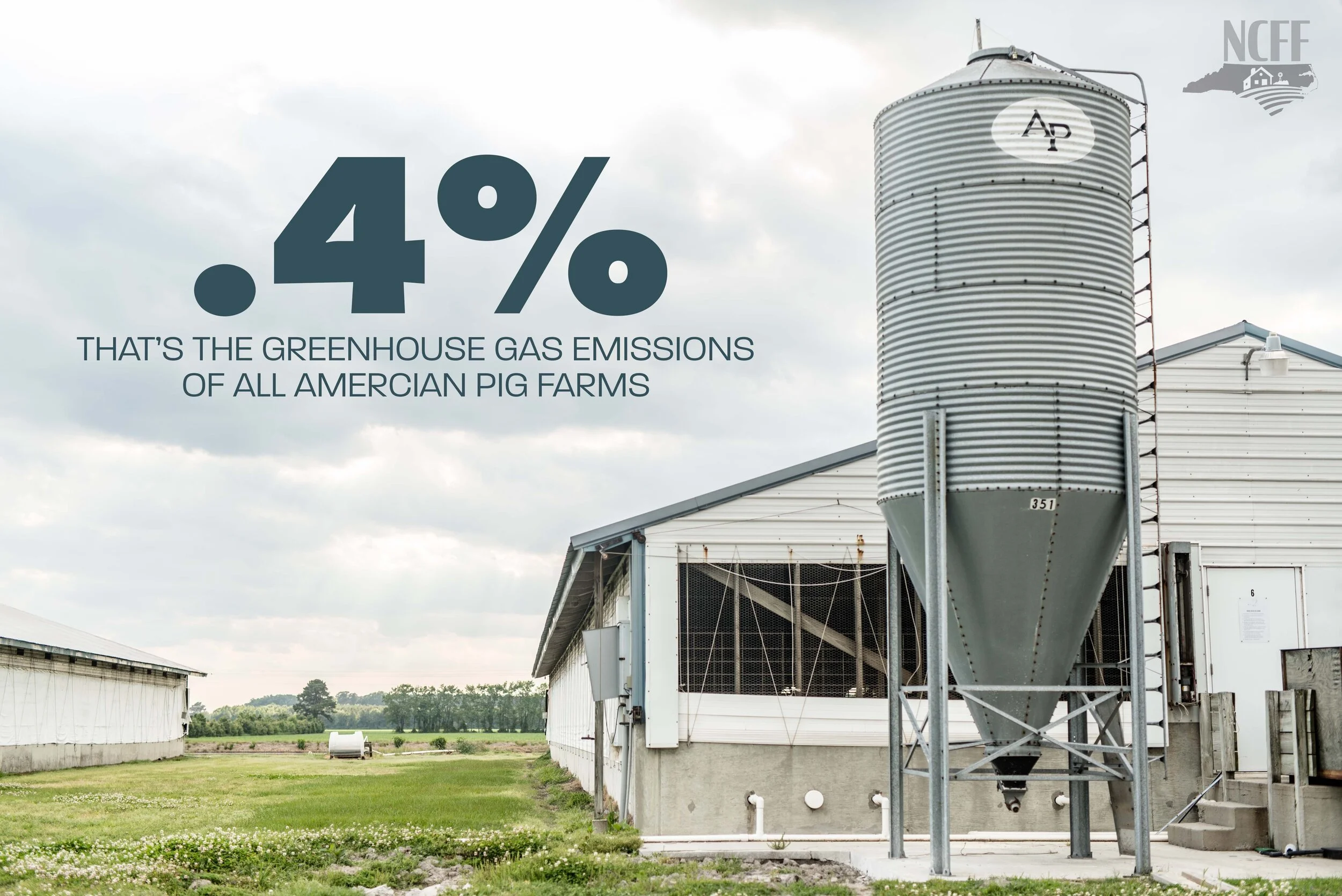
Greenhouse gas emissions in America are caused by several things, the least of these, though is agriculture. According to the EPA, only 10% of GHG are caused by agriculture, with less than 4% caused by livestock. Swine emissions come in at a whopping .4% of total GHG emissions. That’s less than half of a percent.
Yet, .4% is not low enough. They want you to stop eating bacon for four-tenths of the total GHG emissions. Seriously.
Even so, hog farmers and the pork industry are actively working together to reduce that less than half a percent even further.
It gets better. According to the EPA, emissions can be reduced by:
Controlling the way manure decomposes to reduce nitrous oxide and methane emissions.
Capturing methane from manure decomposition to produce renewable energy.
Storing manure in anaerobic lagoons to maximize methane production and then capturing the methane to use as an energy substitute for fossil fuels.
Did you catch that? The EPA suggests capturing methane to produce renewable energy—the exact thing pig farmers are trying to do in North Carolina. But activists still oppose this EPA-recommended tactic. The EPA says, “Capturing methane and using it as an energy sources has a positive impact on the environment, as it avoids methane emissions and displaces conventional fossil fuels.”
Do you know what else the EPA recommends to reduce GHG emissions? “Fertilizing crops with the appropriate amount of nitrogen required for optimal crop production.” North Carolina pig farmers are required to test the nitrogen content of the manure they spread on crops before application to make sure they are not just following North Carolina regulations, but also following EPA recommendations.
The bottom line: activists are blaming us for GHG emissions, while also preventing us from reducing our impact. (We’re confused, too.)
What we do know is that farmers have been doing more with less for a long time. The U.S. swine industry has decreased emissions by 18% since 1990, largely in part because of their determination to always improve and willingness to adopt new technology. Over the past 17 years, North Carolina hog farmers have significantly increased their feed efficiency, resulting in reductions of nutrient content in manure lagoons at farms by 35%-78% and ammonia level reductions of 22%-54%, according to NPPC.
Let’s stop blaming pig farmers (or any farmers) for being the cause of all the GHG emissions. You know the old saying — when you point a finger at someone, there’s three more pointing back at you.
Activists should remember that, especially when flying around in their airplanes to take photos of pig farms. Transportation is the largest contributor to GHG emissions in America and aircraft rank near the top of the list. Who’s the real polluter here?
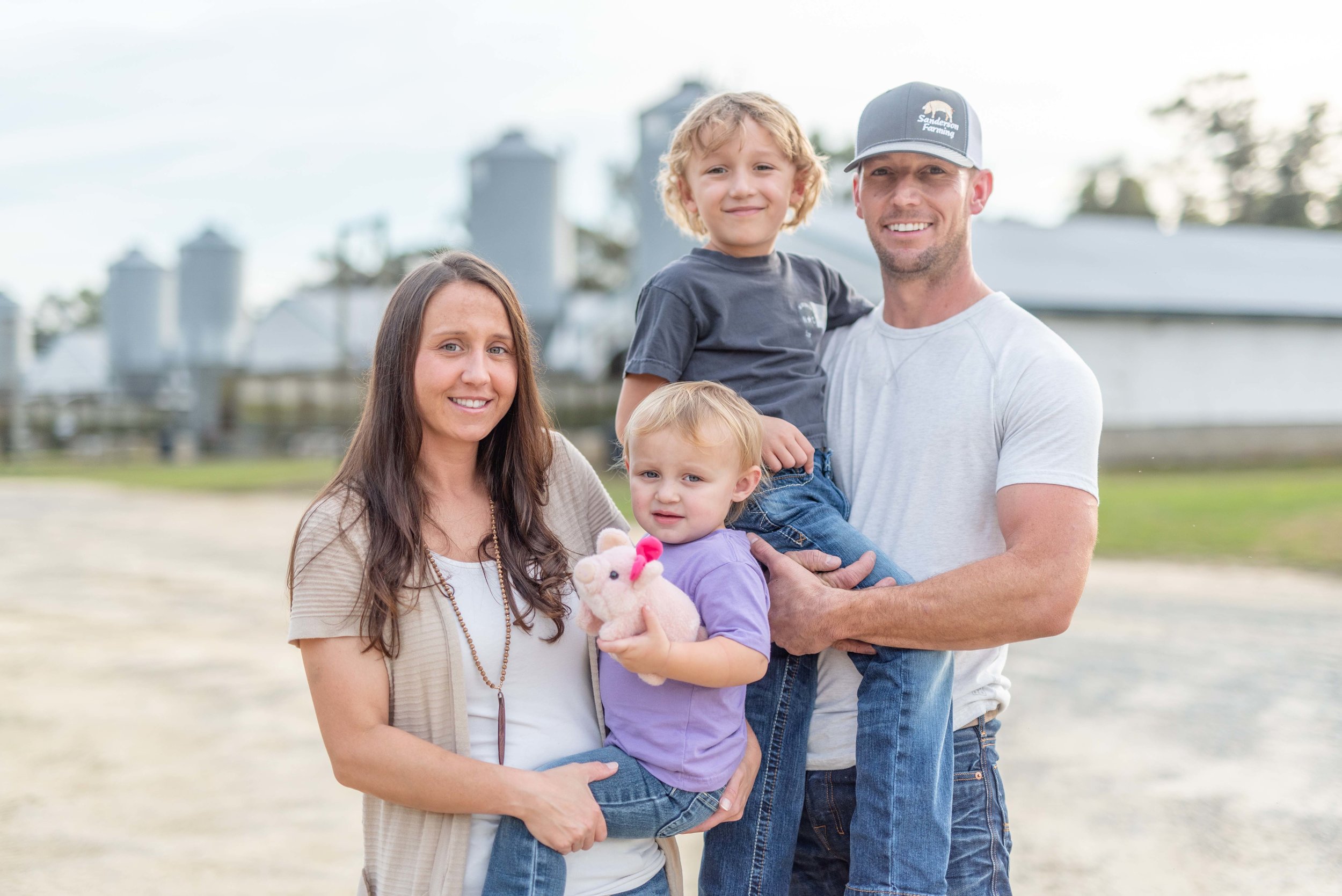
Raising a 5th Generation on the Farm: The Sanderson Family
The Sandersons have farmed land in Eastern North Carolina as far back as the 1850’s growing crops and hogs. The family has been farming the current land in Southwestern Wayne County for 4 generations, and now, another generation is coming up on the farm. The 5th generation already has a passion for pigs, tractors, and the land.
Matt and Andrea Sanderson live in Wayne County where they tend 950 acres of land with Matt’s dad. They currently grow, corn, soybeans, peanuts, and wheat on the farm. In addition to the crops, Matt and Andrea have 10 hog houses that they own together. They are also raising their two children, Spate who is 6, and Tessa who is 2, on the farm.
Both Matt and Andrea grew up around agriculture. Andrea’s grandfather had a small farm where she would help him and his brother in the summers with tobacco.
“I always admired my grandad and always wanted to ride with him on his tractor,” Andrea said.
In high school she got involved in FFA where her love of agriculture grew. She would later become an FFA teacher, and it was actually through FFA that Matt and Andrea met. They recall some of their first dates being on Matt’s farm where Andrea would help Matt work and wash his show steer for the spring show.
As the fourth generation on the current farm, Matt always knew what he wanted to be when he grew up.
“Ever since I knew what farming was, I knew it was what I wanted to do,” Matt said.
Andrea added that when Matt was little, he could be found under the bleachers playing tractors instead of on the baseball field during t-ball games. You could say that for Matt, it was a true calling and in his blood.
“I saw my dad and grandad and uncle do it. My uncle influenced me a lot when it came to hogs. He was a hog farmer, and my dad was a row crop farmer…now we grow both,” Matt said.
Eight years ago, the couple decided to diversify the farm and purchase a finishing hog farm. They just purchased a second hog farm the past year. Growers for Goldsboro Milling, they’ve really enjoyed working with the pigs. Not only does it help diversify their farm but being able to partner with an integrator takes a lot of the risk out for the Sandersons. Goldsboro Milling provides resources, and for the Sandersons, the partnership fits their operation very well.
They appreciate how hog farming can work well with row crops on their farm too. Because of their long history as row crop farmers, they have a deep appreciation for the land and know the importance of taking care of the land.
“They soil sample annually, so they know exactly what the land needs. They do tissue samples on their plants when they’re not sure exactly how much nitrogen the plants need, so they aren’t applying anything on the land that doesn’t need to be there,” Andrea said.
By using technology like auto-steering when planting and autoswath when spraying, they can be more precise, efficient, and better stewards of the land.
“I think we care more about the land and the environment than anybody because we live on it and I’m raising my kids on it. It’s very important to me. We try to do as much conservation farming as we can,” Matt added.
Raising the next generation on the farm means that you must take care of the farm and the land it includes. Andrea and Matt are committed to doing just that. They hope that living on the farm teaches their kids the value of hard work and that it builds their character. They want their kids to have an overall appreciation for the agriculture industry.
“We try to immerse both of them as much as we can whether it’s through 4-H or just having them on the tractor or combine or entering things in the fair. There’s probably not a whole lot of 6-year olds that know what a persimmon or chinquapin is,” Andrea shared. “He’s not just learning about farming, he’s learning about the land around him,” she continued.
Matt also feels that it is important that their kids learn about the land and how to be good stewards of it.
“I want them to learn the value of the land. When they ride by a farm, I don’t want the first thing they think is ‘how many housing lots I can sell off here.’ I want them to think ‘I can grow a crop here to feed the nation off of this land,’” said Matt.
It is their hope that their kids are the next generation to farm this land, and that the legacy will continue.
Spate and Tessa are well on their way. They already have such a young and bright passion for farming, specifically pigs. Spate was able to show pigs for the first time this year. He showed his first set of pigs at the Wayne County Junior Livestock Show and Sale. He enjoyed it so much that he decided to show in the fall as well. During the summer, he worked hard with his pigs and traveled to various shows across the state, competing in the Carolina Swine Showmanship Circuit. Although it was his first time, he won third in the state for his age category. He also competed at the NC State Fair and was recognized for his showmanship there as well.
When Matt was asked his proudest moment as a farmer, his response was not about an award or high yield, he said, “I love seeing my little boy show pigs. That’s probably one of my proudest things.”
While Tessa is too young to show just yet, it doesn’t stop her excitement for the pigs. Spate’s favorite show pig was named Oreo, and for Tessa, all the pigs are Oreo. As she walks the hog houses, holding her favorite toy pig, she points with delight at all the pigs, yelling “Oreo, Oreo!”
The Sanderson kids aren’t just passionate about pigs, they have a passion for other farming subjects as well. To be clear, Spate is a green tractor guy—not red.
Farming isn’t all pig shows and green tractors, though. It’s both stressful and fulfilling. For Andrea, the hardest part about being a farmer’s wife is not being able to help like she’d like to. She hates seeing Matt stressed and struggling. Although she’d like to do more, Andrea does quite a bit on the farm. When she’s not homeschooling Spate, she is doing farm paperwork, records, moving equipment, hauling grain, scouting crops, helping with placing pigs, doing feed reports, checking irrigation, getting parts, and helping wherever else she can. Both Matt and Andrea are certified waste applicators, PQA certified and have their pesticide licenses. Farming is stressful, but by working as a family, they get the job done.
Together, as a couple, they continue a legacy that has been passed down for generations. Together, they are trying new things (raising hogs and growing peanuts). Together they are raising the 5th generation to appreciate and understand the land and farming. Together, they are chasing their dreams. Together, they are a North Carolina Farm Family, and that is a blessing for them.
“I feel that we are very blessed because our children are able to know what the land is and the importance of the land and feeding people of the world.”—Andrea Sanderson
Photos by: M. See Creative
One Farmer's Story
Fake news isn’t just a political phenomenon. If you click on the internet you’ll also find dozens of stories by the groups who are set on tarring and feathering hog farmers. Those stories say a lot of unfair things. One story I read said a woman couldn’t go outside and was a prisoner in her own home due to the odor from the hog farm next door. The problem was the lady was sitting on her front porch, outside, when she said it. Another political-type story – creating more fake news – used a long-discredited ‘study’ to say that hog farmers discriminate against people of color.But, every now and then, you’ll find a story that wasn’t written by a group with an axe to grind. Here’s one from a local newspaper, about a third-generation farmer who raises hogs on his 66 acre farm near Clarkton.