Farmkeepers Blog
The Farmkeepers is the official blog of NC Farm Families. It is here that words will flow, our voice will be heard, a stand will be made, and the farm families of North Carolina will be protected. In these posts, we'll set the record straight. You'll see the faces of the families who feed us. Here, you'll receive all the updates and news. It is here that we will fight for farmers and be the keepers of the farm in NC. We hope you'll join us. Follow along on social media and by joining our email list.
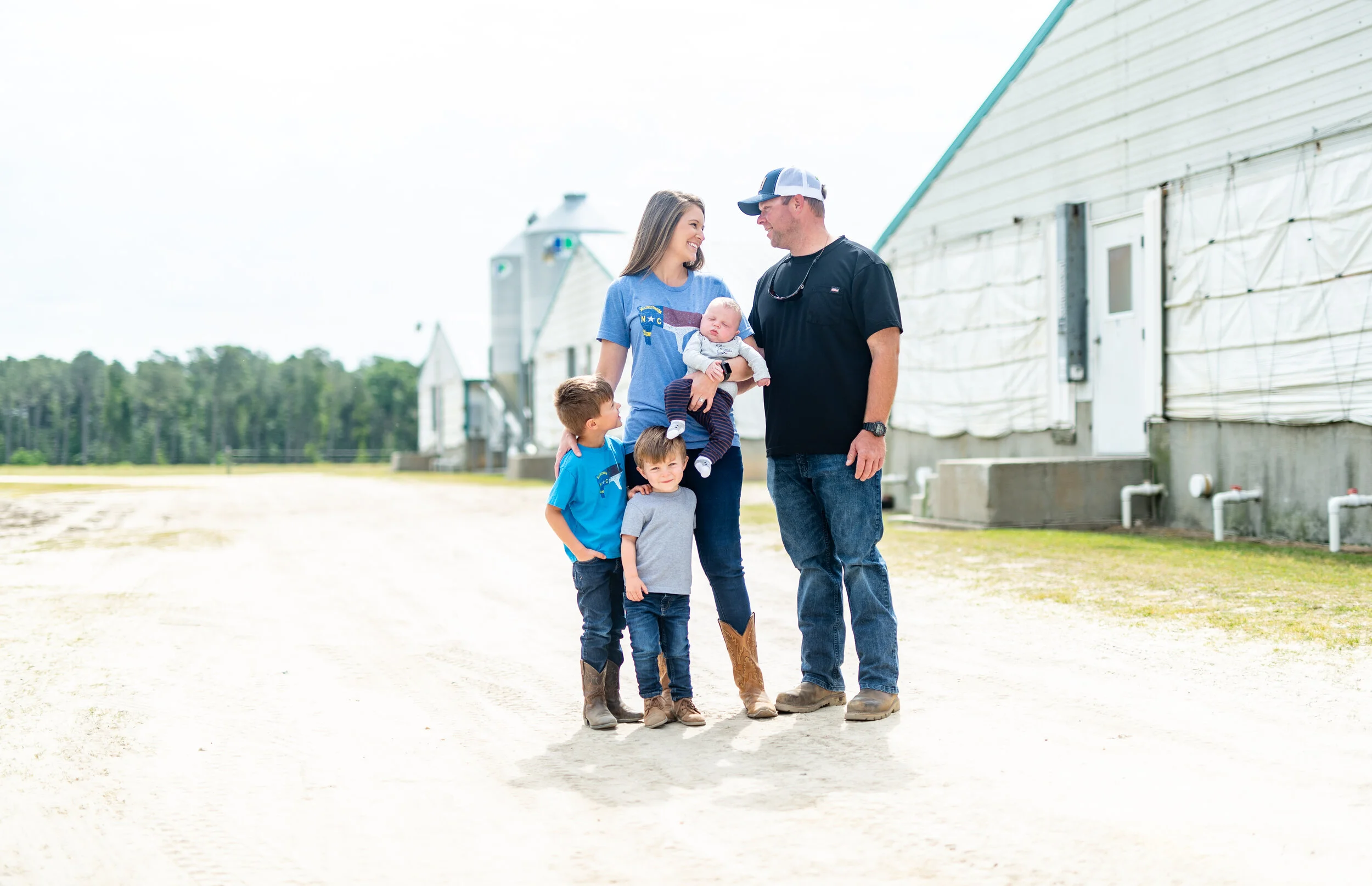
The Bass Family: Raising 3 Sons on the Farm
Knox and Crawford Bass race down the dirt path that runs in front of their family’s hog houses. Crawford, who is currently 5, outruns his younger brother who is almost 3. Not winning any races any time soon is baby brother Zane who is only a few months old.
The Bass boys are right at home on the hog farm—racing, playing in the dirt, checking on the pigs, climbing feed bins. For them, this is what they’ve grown up with and know. This is their element. What they don’t realize, however, are the lessons they’re learning on the farm. Their parents, though, are hopeful that between the dirt path races, tractor rides, and farm play, something bigger is happening in their sons’ lives.
Tyler and Janna Bass met in college at NCSU. Tyler majored in agronomy, while Janna studied business and marketing. Tyler had a clear plan of his future—farming. Janna’s future didn’t have farming in it; that is until she met Tyler.
“When I met Tyler, he said ‘I’m a farmer,” and I remember thinking that I really didn’t know much about that lifestyle and I had no idea what it took to run a farm and the business aspect behind the operation,” Janna recalled.
Janna grew up right outside of Raleigh in an urban area, and the move to the farm in Sampson County was an adjustment. Even after being married for 10 years, there are times where it is still an adjustment. That’s not to say that she doesn’t like the farm life. She has embraced the farm and the farming community. She actually works with farmers now as the Marketing and Financial Service Manager with Cape Fear Farm Credit, an agricultural lender.
“We assist farmers of all shapes and sizes, new farmers or farmers who have been farming for generations, and we help them obtain the financing they need to start, continue or grow their operation and to ensure its success for the future,” said Janna.
Janna loves her job and working with the agricultural community. She also loves watching the passion her husband has for his job and feeding the world.
The Bass farm was started by Tyler’s grandad, and later taken over by his dad and uncle. After college, Tyler knew exactly what he wanted to do—come back to the farm. He had always wanted to be a farmer, after all.
“I’ve always wanted to farm ever since I was a little boy. I can remember playing in dirt paths with my trucks and tractors,” Tyler said.
After college, Tyler started to build chicken houses and bought hog houses since then as well. The Bass farm currently grows and raises crops, produce, chickens, cattle, and hogs. Tyler’s favorite part about being a farmer is being outside, watching things grow, and knowing he is helping feed others.
His least favorite part about farming is also Janna’s least favorite aspect—the time it can take away from family. Farming is 24/7, especially when livestock is involved, and the sun-up to sun-down hours can be hard.
“Many a night during planting or harvesting season we are sitting around the table, and he’s not able to be there, or I tuck the children in bed and he’s not home yet because he’s still in the field,” shared Janna.
Janna and Tyler aren’t trying to downplay the good in farming. They are simply acknowledging the hardship that is their reality. And yet, in that hardship and challenge, is a lesson for their sons.
With the long hours and hard work, their sons get a front row seat to lessons on a good work ethic. While it may seem that they are simply playing, young children tend to notice more than we realize.
“I hope they observe the work ethic behind what goes into a farm, the dedication, and just the humility that comes along with it,” Janna said. “Farmers are humble and honest, but they really put serving others in front of themselves. I hope my boys see that and apply that to every aspect of their lives.”
Whether or not Crawford, Knox, and Zane choose to become farmers, they are learning values that transcend the farm. Humility, hard work, dedication, and service are all traits that any parent hopes their child will learn.
And if the Bass brothers want to become the fourth generation to farm, well, the farmers that came before them have and are putting in the work, sun-up to sundown, to make sure that the farm is able to welcome the next generation on to it’s lands.
“If my boys choose to farm, I hope ag will still be able to sustain them and their families in the future. I hope I can continue to build on the farming foundation my dad and granddad set for me, to pass on to my boys – if that God’s plan for them,” said Tyler of what he hopes for his sons.
The farm is filled with lessons, and for those who are lucky enough to grow up on the farm, they may not even realize that they are learning at the time. It is doubtful that Knox, Crawford and soon Zane Bass realize that as they check on pigs or ride the tractor with their dad that they are learning life lessons.
While family farms are about providing food, fuel, and fiber for the world, they are also all about raising the next generation. Tyler and Janna Bass are striving to do their part, to raise Godly, kind, humble, hardworking boys on the farm.
And perhaps in 20 years, the Bass brothers will remember a time where they raced down a farm path and climbed feed bins, smile and realize that they learned so much on the farm.
While Farmers Continue Efforts to Feed Communities, Waterkeepers Launch Baseless Attack
Here they go again…
When Cape Fear Riverkeeper Kemp Burdette launched another baseless attack on North Carolina’s pork industry last week, our Executive Director Chad Herring didn’t hesitate to call him out.
“You have to hand it to the activists attacking North Carolina’s pork industry — they never let a crisis go to waste,” Herring wrote in a letter to The News & Observer. “First, it was the hurricanes. Now, they are using the COVID-19 pandemic to keep attacking our industry.”
Burdette wrote a guest column taking aim at hog farmers and pork processing plants, including claims that our farms pollute the air and water. But let’s take a look at the facts.
The NC Department of Environmental Quality (DEQ) recently collected 15 months of air quality data in Duplin County. After taking measurements of hydrogen sulfide, ammonia and particulate matter, the Division of Air Quality concluded that the results “do not constitute a significant air quality issue in the study area.” They determined that no additional testing is needed.
Burdette also specifically accuses our farmers of creating water quality problems during hurricanes. But we’ve seen time and time again that you simply cannot trust the claims these activists make — especially during hurricanes and other crisis situations.
As Herring explains in his letter, “When a crisis hits, our family farmers don’t attack others. We look for ways to help. We protect our animals, feed our neighbors, and strengthen our communities.”
It’s a shame the Waterkeepers refuse to do the same.
Letter to the Editor
You have to hand it to the activists attacking North Carolina’s pork industry — they never let a crisis go to waste. First, it was the hurricanes. Now, they are using the COVID-19 pandemic to keep attacking our industry.
The latest example: Cape Fear Riverkeeper Kemp Burdette’s May 10 op-ed.
He repeats a long list of vague, misleading claims about the impact of hog farming on air and water. Burdette also unfairly attacks our state’s processing plants, which are operating at significantly reduced capacity to protect workers and keep our nation’s food chain up and running.
When a crisis hits, our family farmers don’t attack others. We look for ways to help. We protect our animals, feed our neighbors, and strengthen our communities.
Chad Herring, Mount Olive
Executive Director, NC Farm Families