blog-1.jpg

Farmkeepers Blog

The Farmkeepers is the official blog of NC Farm Families. It is here that words will flow, our voice will be heard, a stand will be made, and the farm families of North Carolina will be protected. In these posts, we'll set the record straight. You'll see the faces of the families who feed us. Here, you'll receive all the updates and news. It is here that we will fight for farmers and be the keepers of the farm in NC. We hope you'll join us. Follow along on social media and by joining our email list.  
Faces of NC Farm Families Marisa See Faces of NC Farm Families Marisa See

Heaven on the Farm: The Mewborn Family

“The family farm—is more than a business—the family farm is a lifestyle—it is an ideal worth preserving.”

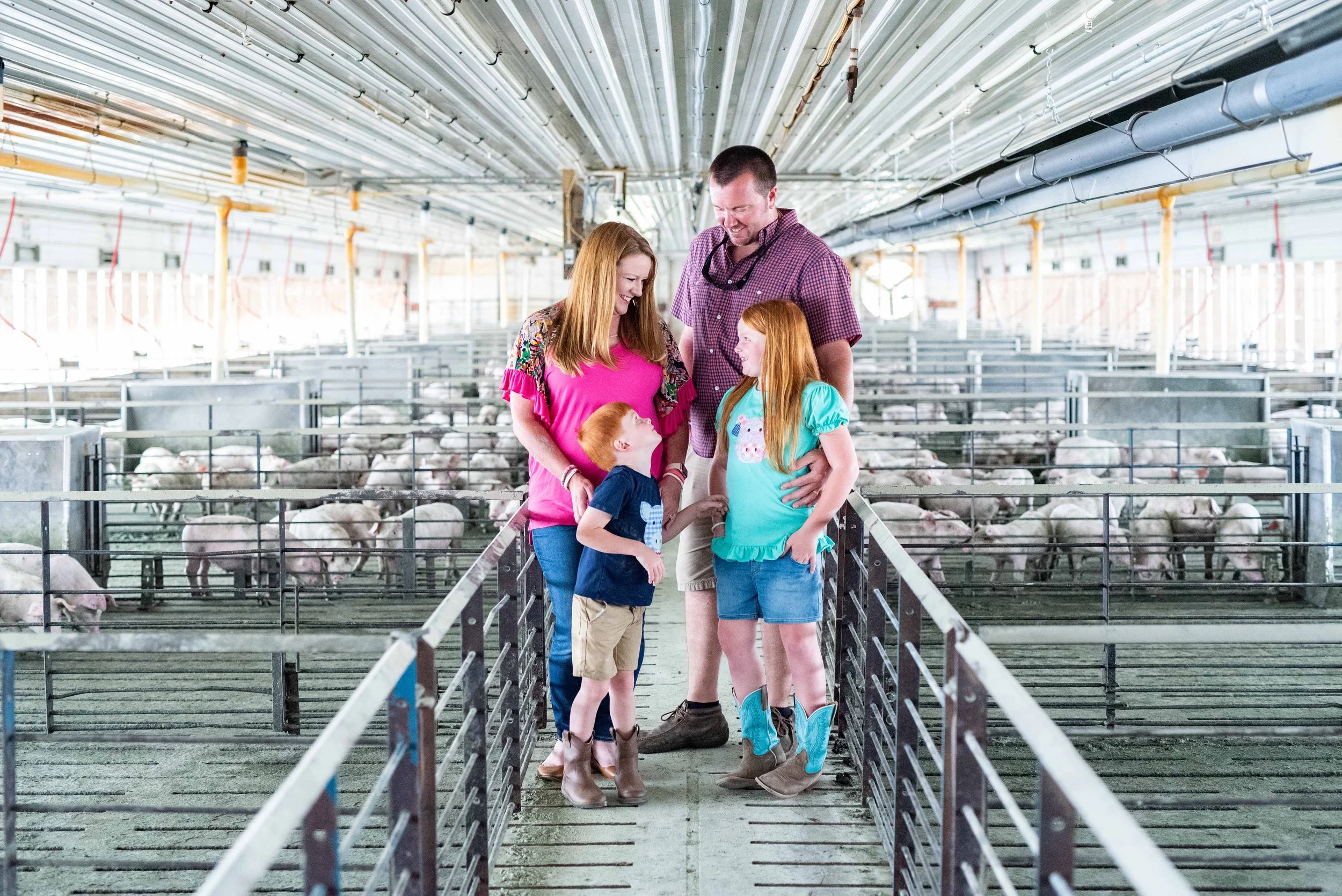
Robin and Wesley Mewborn met in middle school in Duplin County. When they first started dating, Wesley knew nothing about farming; however, Robin had grown up on a multi-generational farm. In 2010, the couple got married. Together, they dreamed of raising their own family on the farm. That dream became a reality in 2014 when they placed their first set of chickens, growing for Case Farms. A few years later, they would add a hog farm and grow for Smithfield.

Although their dream came true, it wasn’t easy. As a first-generation farmer, you start with nothing. When Wesley would ask how he could get started, he was met with statements like, “You don’t. You can’t.” But seven years later, the Mewborns have made it work.

“It just makes me proud to be his wife,” said Robin. “To be that first generation for our children, to grow into that knowing how much work and dedication he’s put into this. His dedication has created this.”

Wesley credits a lot of the opportunity to farm to Cape Fear Farm Credit. “If it wasn’t for Farm Credit we wouldn’t have what we have. They have bent over backwards, so in return they’ve enabled those two [their kids] to have something one day,” Wesley said with emotion.

Robin and Wesley with Shannon Bell and Carrie Cumbo from CFFC.

Farm Credit is more than a lender for rural and agricultural communities. They are also a resource. Wesley says that sometimes, before talking to Robin, he’ll call the folks at Farm Credit to ask if something is a smart move or will something work? “When they say yes, I go home and say, ‘hey, Robin guess what?’” said Wesley.

Farm Credit invests in farmers and rural communities because they recognize just how much farmers bring to the table—literally.  Thanks to them, families like the Mewborns have the chance to chase their dreams and become first-generation farmers.

“I’m excited for us to be here and farming because that’s what I’ve always wanted to do-- that and raise our kids here,” Robin said. “I love the freedom of it. They can come [to the farm] and learn.”

Being able to do that is special for Robin, as she has fond memories of being picked up from school by her mom to go spend time on the farm with her dad. Now, she gets to do the same thing with her children.

Robin doesn’t just want her own children to learn about farming. She extends those lessons to her own classroom. Robin has taught in Duplin County for 16 years at the same elementary school she attended as a girl. Through Farm Bureau’s Ag in the Classroom, Robin ensures her students are learning all about agriculture through activities like hatching chicks and raised bed gardens. One thing she hopes that her students and her own children realize is that agriculture is a vast field.

“There’s more out there than just farming—welders, electricians, truck drivers—those jobs are available. They can stay in Duplin County and do those jobs,” Robin shared.

Farming and agriculture also offer opportunities for girls too. Robin and Wesley want their daughter Macy (8) to know that “it’s not just a man’s job. There’s something for her here too.” Macy’s favorite day on the farm is when they get new baby pigs or chicks. Meanwhile, her brother, Case (4) loves all things tractor. He can tell you names, models, and colors. He also takes farm work seriously.

“When you pick him up from school, it’s ‘my daddy needs me to check the chicken alarm, or my daddy needs me to go to the hog houses and pump.’ He comes ups with it all on his own,” said Wesley.

In many ways Wesley and Robin farm for their children—all three of them, although you will notice only two of them are with them today. Robin and Wesley’s firstborn, Layla was diagnosed with brain cancer when she was only 3 months old. The young family went to Duke every week for treatments. At the time, they were just starting to build their chicken houses, so were not farming yet. Robin was 7 months pregnant with Macy, and Wesley had been laid off his job.In October of 2014, their first set of chickens arrived. For the Mewborns, farming was a blessing in so many ways. Not only did it provide a job for Wesley, but it allowed for more flexibility as they continued traveling with Layla for care and treatment.

Layla passed away on her fourth birthday in 2016 at Duke. She was in palliative care for two weeks prior, and Wesley was able to be there every day, something that he might not have been able to do with another job.

Today, they continue to remember Layla in all they do, including farming. Their smaller hog farm is named LMC after their three children.

Robin, Macy, Wesley, and Layla

Layla and Wesley

“In our farming day to day, we remember Layla. She is also our child. Honoring her in just naming our farm and in the day to day is a huge part of our story. She is a part of this even though she is not here, and it gives us that drive,” shared Robin.

They say when you see a cardinal, it is a visitor from heaven; every time they see a cardinal, they remember Layla. Frequently, the family will see red birds at the farm. For some, the farm is a slice of heaven on Earth, and for the Mewborns, that is especially true.

Read More
Faces of NC Farm Families Marisa See Faces of NC Farm Families Marisa See

West Family Farm: Here’s to Hoping

“I can’t think of another job that I’d enjoy as much and take pride in as what I do here [on the farm]. It can be tough, but I can’t think of another job I’d rather have.”—Lee West, Fremont, NC

Farmers are eternal optimists. The saying goes, “they have to be, or they wouldn’t still farm.” Bad weather, low commodity prices, a pandemic...farmers all over the country are still farming with a flame of hope and pure grit that is rarely seen. The West family is no different.

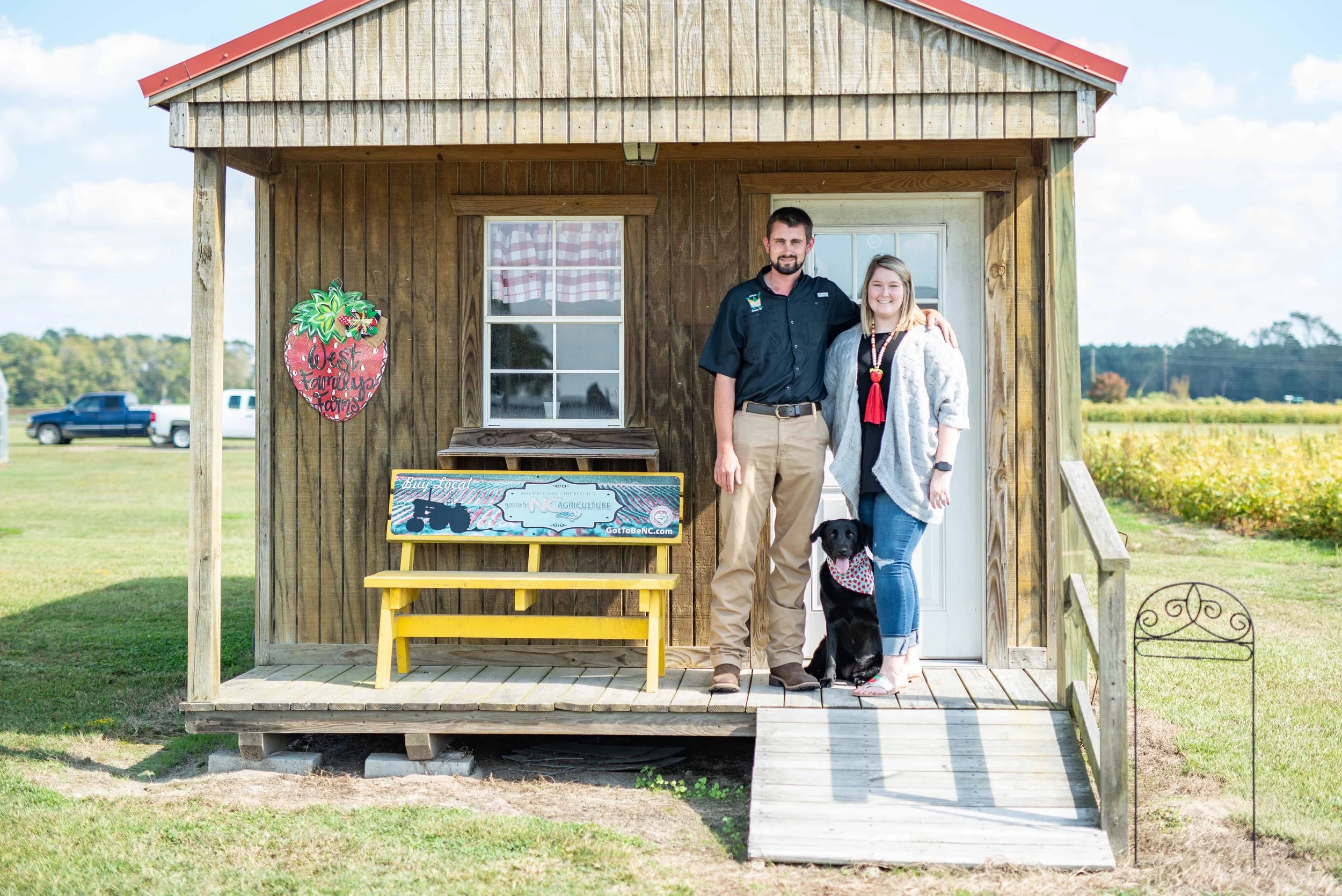
Lee West, a sixth-generation farmer, and wife Madison live in Fremont, NC, on their family’s third-generation farm, where three generations still work. “It’s definitely a family farm,” Lee says of West Farms. The family is hands-on every day. Each does their part to grow crops and livestock.

Together the family works to grow sweetpotatoes, corn, soybeans, tobacco, cotton, peanuts, turkeys, pigs, strawberries, sweet corn, and other produce.

Lee, his dad Craig, uncle Brad, and brother Luke, focus on the crop side, while Lee’s mom, Nell, looks after the turkeys. Madison is your go to girl for strawberries. Lee’s Aunt Lynn handles a lot of the office work, and his grandmother, Audrey, who says she’ll retire every year but never does, also heads to the office every day—something that’s good for her and the rest of the family.

Working together 80-90 hours a week with your family is not for everyone, but for Lee it means a whole lot.

“Running the big John Deere tractors is nice, but the thing that probably means the most and is the most important to me, and I enjoy the most is the legacy. The same farm my grandaddy worked, my dad worked, and now I work, that just really means a lot to me—being able to work with my family and spend time with them,” Lee shared.

For Lee, farming is all he’s known, but for wife, Madison, the same cannot be said. Madison grew up in insurance as the family business.

“I knew nothing about farming at all until about nine years ago when we started dating,” Madison said. She got thrown into farming from the start. On their first date, Lee picked her up and went straight to move a piece of equipment before their date officially started. Nine years later, Madison and Lee are now married, recently celebrating their first wedding anniversary.

As her Instagram handle @talesofanaccidentalfarmgirl suggests, Madison didn’t mean to become a farmer, but here she is, loving it and “wouldn’t trade it at all.” Although, she works off the farm at a financial institution Monday-Friday, she runs the family’s strawberry patch. March-May is strawberry season and top of mind for Madison. You can find her at the strawberry barn during that time with their dog, Millie, selling strawberries.

Taking the Good with the Bad

Of course, farming hasn’t been just strawberries and tractors for the Wests. They’ve been hit with some hard times, especially of late.

Lee points to the last day they had pigs on the farm—January 2021

Two months before Madison and Lee’s wedding, they got the call that Goldsboro Milling was shutting down their hog operations. It was news that shook farmers and communities across eastern North Carolina. For the Wests who had just bought a 2,000 head sow farm less than a year before, it was an extremely hard blow.

“It was stressful. We didn’t know what was going to come of it. I was at work when I read it, and didn’t know what to think,” Madison said.

Today, their barns stand empty. The silence is eerie. The emptiness swallows you. There are dusty boots in the farm office, abandoned. Birthday balloons lay deflated from better times. The calendar shows January 2021—the last days.

They wanted to diversify their farm and income with the pig farm. Now, they must rely on turkeys and crops to pay for empty hog barns.

Lee is quick to say that this wasn’t just a blow to them, though. This impacted families across the community, especially those that worked at the hog farm.

“When you have a group of 10-11 workers that are what I would call, cream of the crop, it’s hard to turn them loose. Some of those guys have been here 20 years or more. That’s their career. That’s tough on them,” said Lee of the team that worked at the hog farm, most of which stayed on from the previous owner when the Wests bought the farm. “You wonder, will they be able to find a job? It’s not just our farm that’s shutting down; it’s the whole industry around here, so the job market for those guys is minimal.”

The Wests tried to find jobs for the hog farm employees elsewhere on their farm, but it wasn’t the same. Losing a career that you loved and did for decades is hard. For a family that considers their employees extended family, it was an added heartbreak to already devastating news.

And yet, despite all of this, they are hopeful for the future. They aren’t giving up.

“We’ve got to take the hand we’re dealt and do the best we can with it and hope something comes along soon,” Lee said. “We bought a hog farm. We’re serious. We want to be in the hog industry.”

So, they continue. They’re still farming. Still planting and harvesting. Still praying and hoping.

While they wait for something to come along, they are providing grain through their crops to feed mills across the state. That grain will ultimately be fed to other farmers’ poultry and hogs. So, while they currently don’t have pigs, they are still very much a part of the hog industry through the crops they grow and their hopeful hearts.

Farmers are optimists. Really, it’s the only way to continue farming. As Lee said, “you have to take the good with the bad.”

As Madison decorated their Christmas tree this year, she snapped a photo of a pig ornament and posted it online with the caption: “Some cultures believe that pigs bring good health and good fortune. We hung this special one on our tree again this year with the hopes that it will fill our hog houses back up in 2022.”

Here’s to hoping. Here’s to taking the good with the bad. Here’s to farmers, the eternal optimists.

Read More
The Truth About Farmers Marisa See The Truth About Farmers Marisa See

"NC Hog Farmers Important" say Activists | Contradict Statement with Actions

“Although we understand that the pork industry is important…”

Words said by activists opposing North Carolina hog farms and their efforts to implement innovations.

They say that they understand that the NC pork industry is important, but do they really?

Do they comprehend what 44,000 jobs looks like?

Do they understand what $10 billion does for the state’s economy?

Do they know that our hog farmers feed 20 million people every year?

Do they realize just how important the pork industry is to NC families and communities?

The same families and communities they are supposedly advocating for and protecting.

Saying “we understand that the pork industry is important,” while suing us, filing legal complaints against us, attacking us, blocking efforts to implement innovative technology, and even effectively causing farms to shut down — saying we’re important while simultaneously scorning us is a backhanded compliment that no one is falling for.

They don’t believe we are important. They only say that to save face and bolster credibility. To them, we are a scourge to this state. We cause egregious injustices, pollute the environment, and are greedy. We are not important. It would be just fine if we were run out of town.

DSC_2200.jpg

And even if they do mean what they say and understand the positive impacts the pork industry has on North Carolina communities, their actions and words tell a different story.

Here are two examples:

(1) “Although we understand that the pork industry is important, researchers have repeatedly found that pollution from the state’s industrial hog operations disproportionately affect African Americans, Hispanics, and Native Americans in a pattern that they concluded, ‘is generally recognized as environmental racism.’’’—Robert Moore, president of the Duplin County Branch of the NC Conference of the NAACP.

The research that they refer to is flawed and inaccurate. Hog farms do not disproportionately affect these groups. The pork industry does not impact communities in such a way that is to be considered environmental racism. Whatever importance they see in the pork industry is clearly nullified by their opinion of the affect hog farms incur on certain communities. What’s more, their incessant need to use bogus and negligent research shows they are not interested in truly recognizing the benefits the pork industry offers.

(2)  During the nuisance lawsuits against hog farmers, covered lagoons were highlights as an example of a better, more sustainable option than the current lagoon system. But when the pork industry made efforts to implement covered lagoons that would create renewable energy, the opposition was fierce. Why are these activists trying to stop farmers from implementing sustainable and innovative technology that is good for the community? Because they don’t truly believe the pork industry is important.

Long story, short, when these groups say that the pork industry is important, it rings hollow and untrue. It’s an effort to play the good guy. They don’t believe it, not really.

Farmers are humble, hard-working people who don’t like to shout about our importance. But we know our worth. We just wish these groups did, too.

Read More